
How to Validate a Business Idea Before You Spend a Penny
How to validate a business idea for free: customer interviews, competitor analysis, Fake Door tests, MVP and pre-sales. Find out if the market wants it.
Contents
How do you check whether your business idea makes sense before you spend a single złoty on it? All it takes is testing your key assumptions in direct conversations with potential customers and gathering hard evidence of interest, instead of building a product based on gut feeling. Early validation saves you months of work and protects your budget from a project that misses the mark.
What is business idea validation and why is it worth doing before you spend money?
Validation is a structured check of the weakest assumptions in your project before you invest in code, production or registering a company. It's not about hearing from friends that it's a cool idea, but about finding what could overturn the whole business: whether the problem really exists, whether you know how to reach your audience and whether anyone will actually reach for their wallet. At this stage you invest time in knowledge from the market, not in building a finished product.
The most common reasons new businesses fail
Most startups fail for a simple reason: founders fall in love with their solution before they properly understand the customer's real problem. Instead of asking "what interesting thing can I build?", it's better to check what simply doesn't work in your audience's daily work or life.
A lack of understanding of needs, too broad a target group and ignoring existing alternatives lead to technically polished products that nobody needs. Sometimes it also turns out that the value lies somewhere completely different from where you originally assumed (like Play-Doh, which started out as a wallpaper cleaning compound). Flexibility and a readiness to change direction are essential.
The benefits of checking your idea early
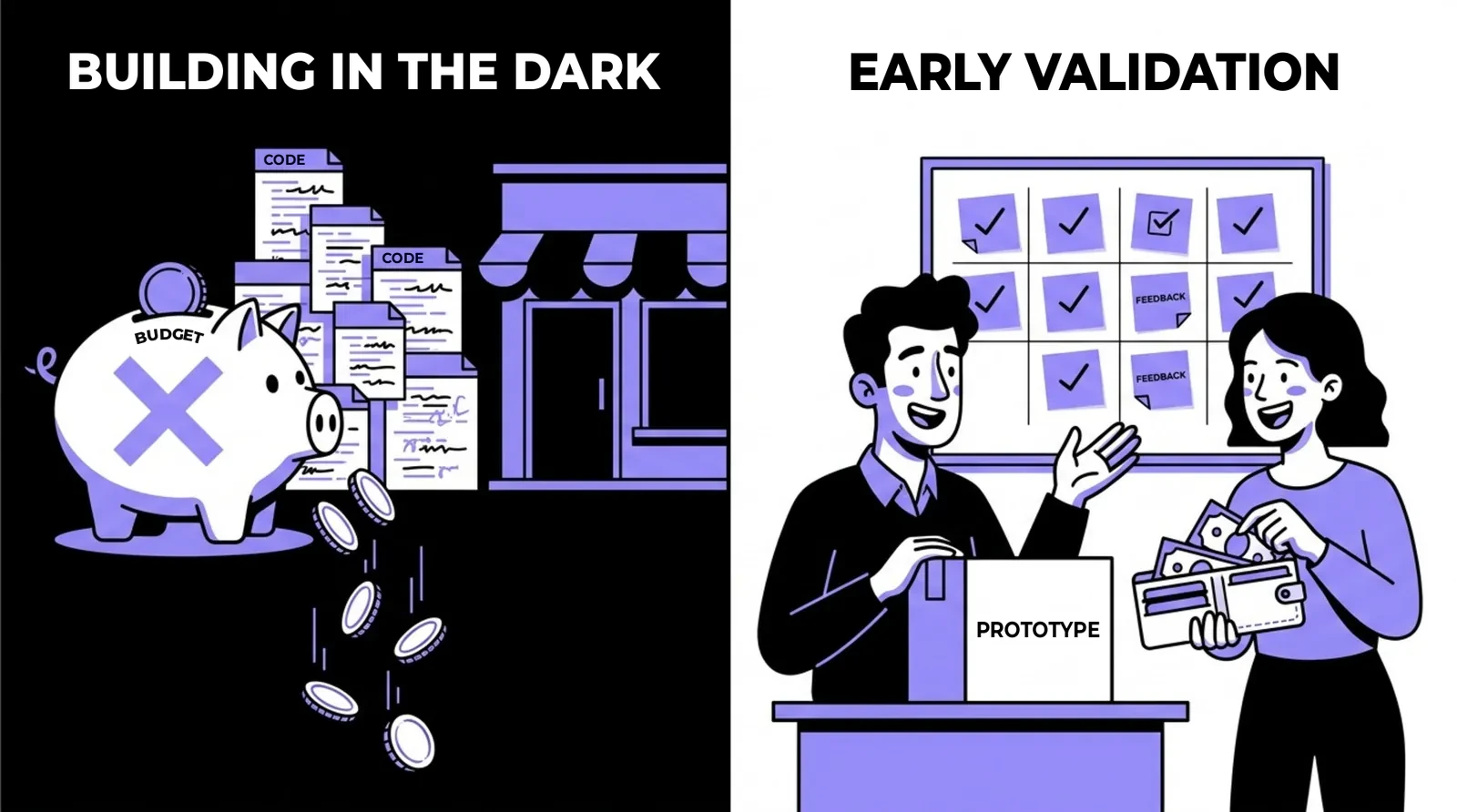
Early validation is a shield for your time and your wallet. Instead of building a product in the dark and hoping customers will come on their own, you verify straight away whether anyone needs it and collect honest feedback from the market.
Of course, you'll learn the most from potential customers themselves, but it's also worth testing your assumptions against people who have been through building products, winning first customers, pivots or talks with investors. That's exactly why communities such as Startup Community Poznań exist, where founders, investors, experts and people who are only planning their own business meet regularly.
Conversations like these let you look at your idea from the perspective of people who aren't emotionally attached to your solution. They can point out assumptions you haven't tested yet, suggest a simpler way to reach the market or connect you with someone worth talking to.
You can gather even more of these perspectives at Startup Community Summit, which brings together founders, investors, operators and people building the startup ecosystem. If you're at the validation stage, it's worth treating an event like this not just as networking, but as an opportunity to have many valuable conversations in a short time: about the problem, the market, the business model, funding or the next steps in developing your project.
You learn discipline: instead of guessing, you test, and instead of adding more features, you cut everything that doesn't directly solve the main problem.
What signals show that an idea has market potential?
Potential shows in people's concrete behaviour, not in polite praise. Look for evidence that you're tackling a painful problem that people are willing to pay to have solved.
How do you assess whether a market really exists?
A market exists when a problem comes up regularly and is annoying enough that people are already trying to deal with it - even if they do it in a roundabout, slow and inconvenient way. Pay attention to everyday habits:
- whether they patch the process with makeshift fixes (e.g. complicated Excel spreadsheets),
- whether they openly complain about the available tools or services,
- whether the problem costs them time, money or nerves,
- whether they actively search for solutions online and ask about it in communities.
Free tools are useful for an initial look at demand: Google Trends, Google Keyword Planner or Answer The Public. They'll show you what people are actually searching for and whether interest in the topic is growing.
Does your idea solve a real problem?
A good idea has to remove a specific obstacle, not just add yet another unnecessary option. Instead of asking "what product can I create?", start with the question: "what is most broken in my audience's work?".
You'll recognise real validation by specifics in the answers: "if you build this, I want to be the first to test it" or "right now I lose three hours a week on this". An empty "sounds interesting" has no market value whatsoever.
Stages of validating a business idea without spending money
Checking an idea requires a simple plan and consistency, not a big budget. The point is to assess the facts soberly and not be afraid of difficult answers.
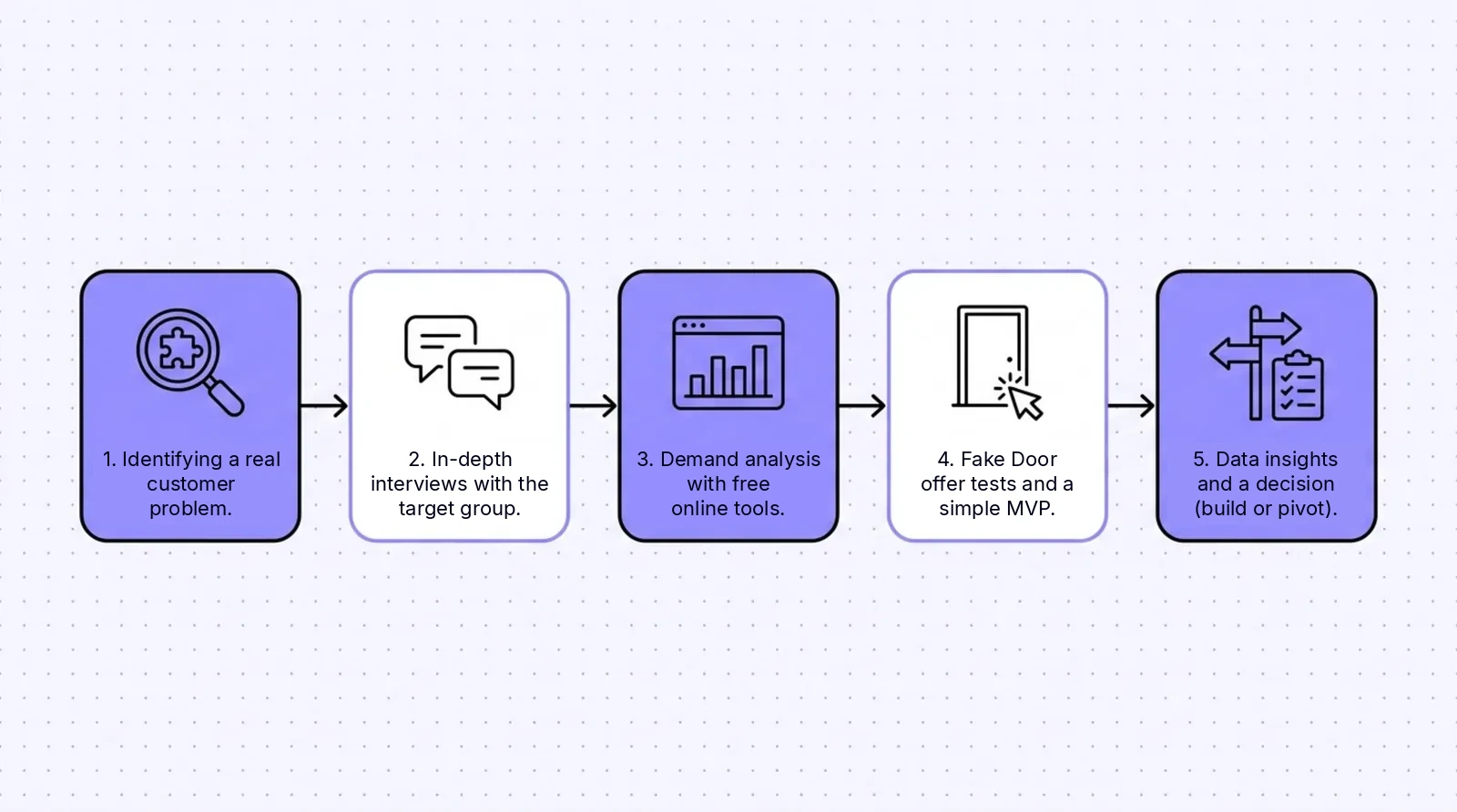
Conversations with potential customers - how to collect honest opinions?
A direct conversation is the fastest and cheapest validation method. Avoid questions like "do you like my idea?" or "would you buy something like this?". That way you'll only get polite, useless declarations.
Instead, ask about facts from the past and the present:
- "How do you deal with this problem today?"
- "What is the most irritating part of this process for you?"
- "What tools have you already tried and why did you stop using them?"
- "How much time or money does this problem cost you per month?"
Look for people to talk to outside your inner circle: in industry groups, on forums, on LinkedIn or Reddit. Offer a short, 20-minute conversation without selling anything. Validation starts where honest feedback appears.
Analysing competitors and existing solutions
Having competitors is a good sign - it means the market exists and people are already paying for a solution. Do a simple SWOT analysis, read user reviews of competing products and note down the recurring complaints. This is often a ready-made list of gaps you can address.
Also check who failed in this market and why. You don't have to reinvent the wheel, but you need a clear answer to why a customer should choose you in particular - for example because of a simpler process, better service or a focus on a narrower niche.
The free version of SimilarWeb will help you peek at traffic on competitors' websites and understand how they reach their audiences.
Estimating demand and interest based on market data
Instead of relying on intuition, pull out hard data:
- Google Trends - shows search trends and seasonality in a given industry,
- Google Keyword Planner - shows the number of searches for key phrases,
- Facebook Audience Insights - helps estimate the size of a group and its interests,
- Answer The Public - generates a list of specific questions people ask online.
This set is more than enough to make an initial assessment of the scale of interest in a topic without paying for expensive reports.
Effective ways to test a business idea at no cost
Once you've had your first conversations and know where the problem lies, it's time for practical market tests without committing capital.
Fake Door: how to check interest in an offer without a finished product?
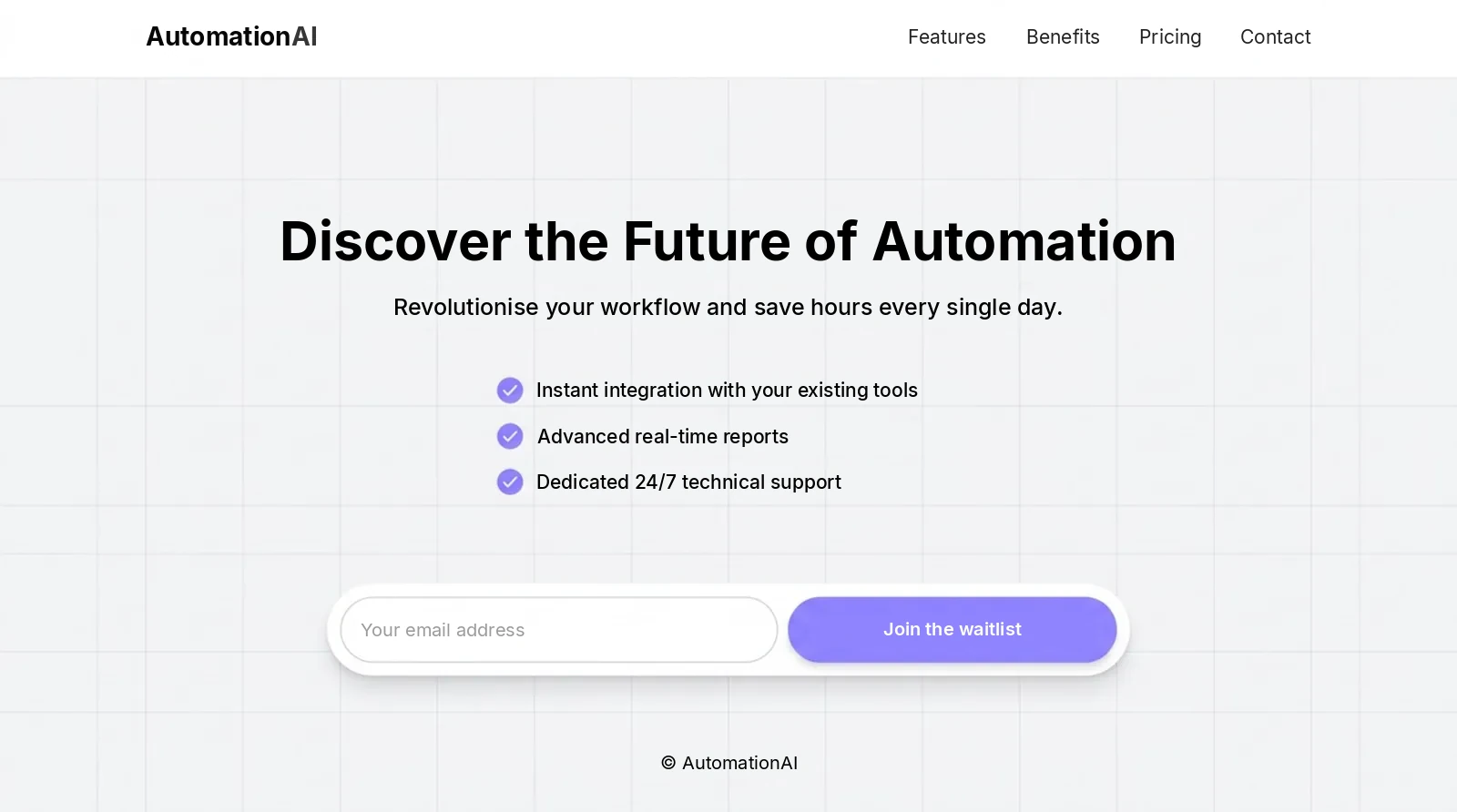
A Fake Door test involves presenting an offer as if the product were already available, even though work on it is still in progress. A simple landing page describing the value, with a form to join the waitlist or a request to get in touch, is enough.
You can drive traffic to the page with social media posts and direct contacts in your industry. The number of email addresses left will give you a clear signal of whether the proposition attracts attention. Just remember to be fully transparent - after someone signs up, tell them plainly that the solution is still being prepared.
Nick Swinmurn of Zappos started in a similar way, testing demand for selling shoes online before investing in his own warehouse.
Minimum Viable Product (MVP) - how to build a minimum version without investment?
An MVP is the simplest version of a product that delivers basic value and lets you collect feedback from real use with minimal effort. At the start, an MVP doesn't have to be an app or an advanced system at all.
Examples of free MVP formats:
- an online workshop or webinar instead of an extensive course,
- a short PDF guide instead of a full book,
- handling the process manually "behind the scenes", which you'll later automate with software.
The point is for the user to go through the process and solve their problem. Then you'll immediately see what causes difficulty, what needs improvement and whether the customer really wants to come back.
Unregistered activity - testing your offer and serving customers without formalities
Unregistered activity (działalność nierejestrowana, a Polish legal form that lets you earn small amounts without setting up a business) allows you to test sales in practice safely. As long as your monthly revenue stays within the statutory limit, you can legally provide services or sell products without having to register a company or pay ZUS (Polish social security) contributions.
It's a convenient solution if you have a full-time job and want to check whether customers will really pay for your offer. All you need is to keep a simple sales record and settle income tax in your annual tax return. The first payment from a stranger is the strongest proof that your idea makes sense.
Crowdfunding and pre-sales as validation tools
A crowdfunding campaign or pre-sale is a simple market test: you check whether people are willing to back the idea with their own money before the product goes into mass production.
The main advantages of this approach:
- you verify real demand with the customer's wallet,
- you gain visibility and your first contacts,
- you build an engaged community of early users around the project.
In a pre-sale you can offer a lower price in exchange for patience and feedback. This way you get funds to refine your offer and confirmation that the market is waiting for it.
Tools and support for validating a business idea
Validation becomes easier when you base it on a proven framework that helps you structure your thinking and avoid chaos.
Business Model Canvas and the Kraus test: a quick analysis of value and costs
For an initial analysis, the best fit is the Lean Canvas - a one-page template divided into 9 key areas:
| Element | What do you write in it? |
|---|---|
| Problem | The customer's three most important problems |
| Customer Segments | Who exactly faces this problem |
| Unique Value Proposition | A clear reason why your solution is worth choosing |
| Solution | How exactly you address each of the defined problems |
| Channels | How you'll reach your audience |
| Revenue Streams | The pricing model and how you charge |
| Cost Structure | Key fixed and variable expenses |
| Key Metrics | Numbers that measure progress (e.g. sign-ups, conversion) |
| Unfair Advantage | What others can't easily copy |
A simple test by Janet J. Kraus can complement it. Ask yourself what your product is: oxygen (an absolute necessity), aspirin (it relieves a burning pain) or jewellery (it gives pleasure). Solutions that work like aspirin or oxygen are the easiest to sell.
Practical market research tools available online
Free tools are enough for initial analyses: Google Trends, Google Keyword Planner or SimilarWeb for checking competitors' traffic.
Paid analytics platforms only become useful once the project gains traction and you start thinking about scaling. At the stage of verifying assumptions, free sources fully cover your basic research needs.
Common mistakes when validating an idea - what to avoid at the start?
Knowing what not to do saves as much time as running the tests correctly.
Guesswork instead of contact with the market
The most common mistake is relying on the opinions of friends and family. People close to you usually cheer you on and praise the idea so as not to hurt your feelings. Such declarations, however, have nothing to do with market reality.
You need to step outside your own bubble and talk to people who have no interest in being nice to you. Only actual behaviour and readiness to act count, not polite praise.
Putting money into the product too early
Investing in advanced code or warehouse stock before demand is confirmed is a straight road to burning your budget. Many people confuse mere interest with purchase intent and start building a complex product before making sure anyone needs it.
Approach it as a process: first confirm the most important assumption at the lowest cost, and only then build the next elements.
Dismissing negative feedback
Critical feedback is the most valuable information from the market. Instead of ignoring it or explaining it away, treat it as a clear signal: what is unclear, what doesn't work or which feature is unnecessary.
Validation only makes sense if you set the conditions in advance: which results mean continuing, and which signal a change of assumptions or closing the project. The ability to quickly abandon a direction that misses the mark saves months of unproductive work.
When to say "no" and what are the next steps after verifying your idea?
Once you've collected the data, it's time to make a decision. Soberly giving up on an idea that isn't confirmed by the market is a standard part of building a company.
How to read the signals you've collected from the market?
Assess the data you've collected through specific indicators:
- how many people want to book another conversation,
- how many people ask about the rollout date and pricing terms,
- how many people say the proposed solution directly eliminates their problem,
- how many people leave a deposit, join the list or pay for pre-sale access.
Hard currency and committed time are the only reliable indicators. If you hear nothing but compliments, but nobody takes the next step, your assumptions need checking.
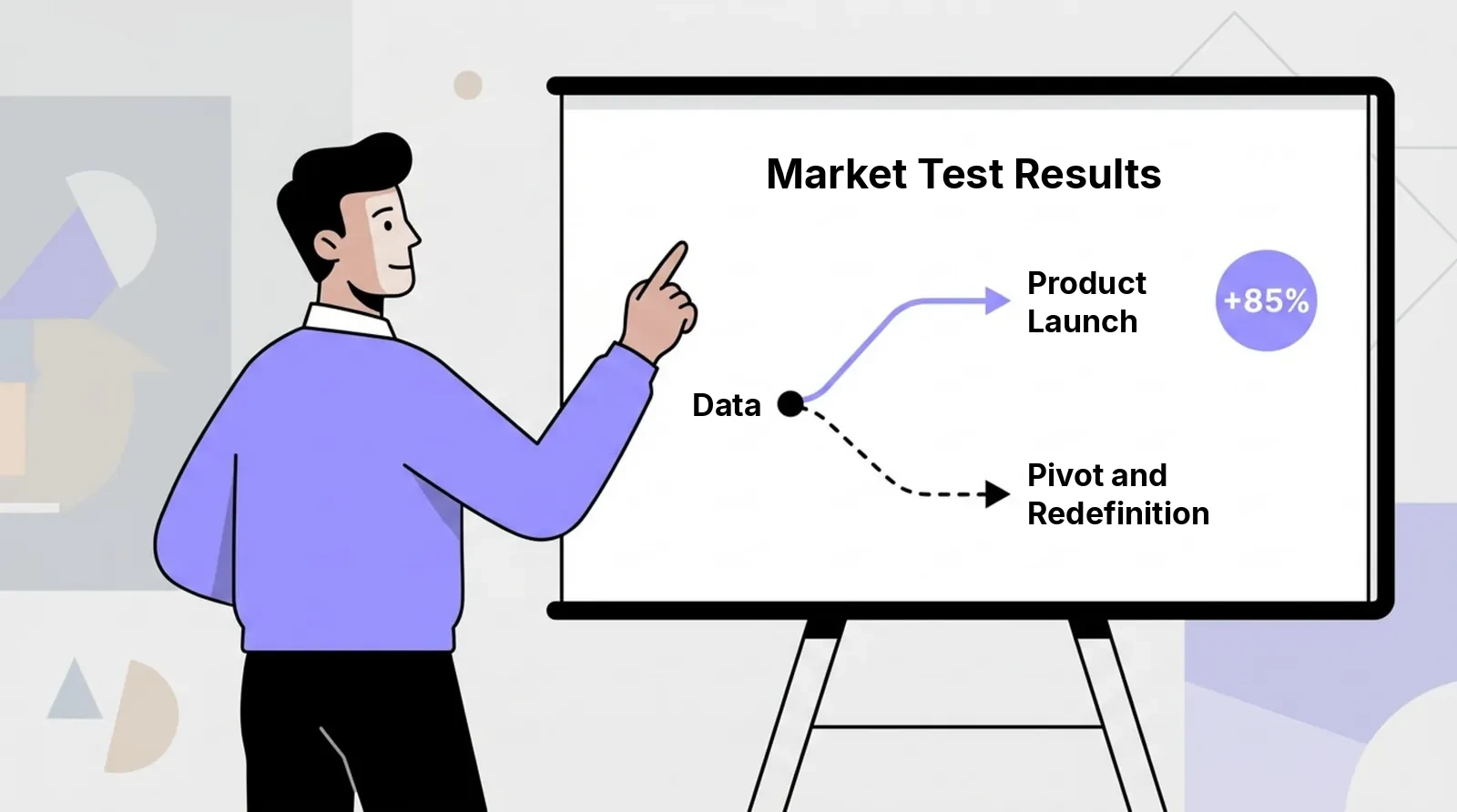
Decision: keep developing or change the idea?
If your tests have confirmed that the problem is painful, the value is clear and customers are ready to pay, you can move on to building the product. Start simple and keep implementation costs low.
When the signals are negative, don't force the idea. Instead, you can:
- change the target segment,
- reframe the problem you're trying to solve,
- pivot and propose a different solution,
- let it go and test another concept.
Exchanging experiences with other founders helps a lot in verifying assumptions, for example within the Startup Community Poznań community. Direct contact with people who build startups and face similar challenges makes it easier to get honest feedback, test your assumptions against practice and make the right decision faster.
Good validation is above all about asking the right questions and drawing conclusions from real market behaviour. If you can explain precisely what problem you solve, for whom and why right now, you have a solid foundation for developing your project further.
Keep reading
All articles →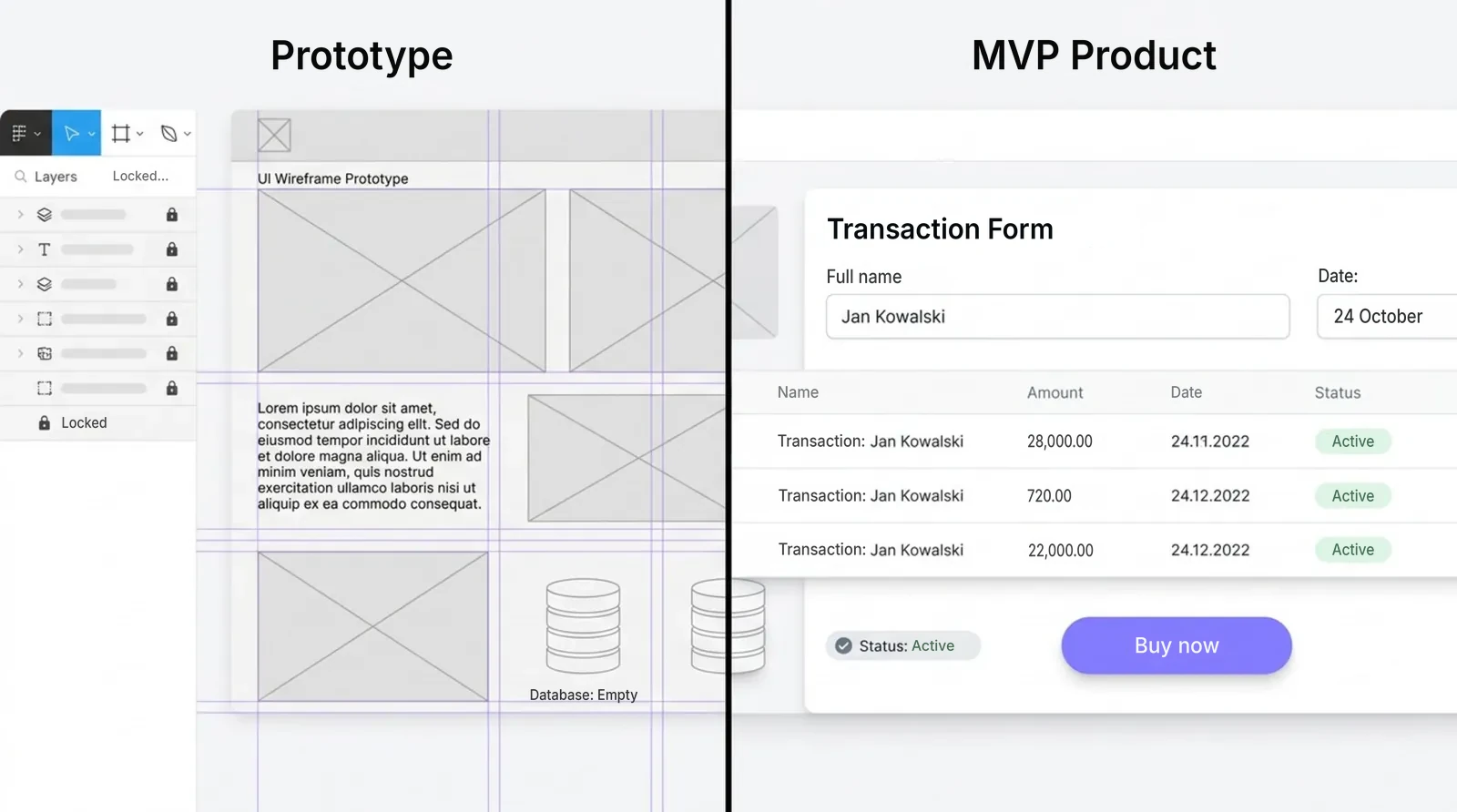
How to Build an MVP Without Losing Your Mind: A Practical Guide
How to build an MVP step by step: definition, process, key metrics, common mistakes, legal basics and examples of companies that started with an MVP.
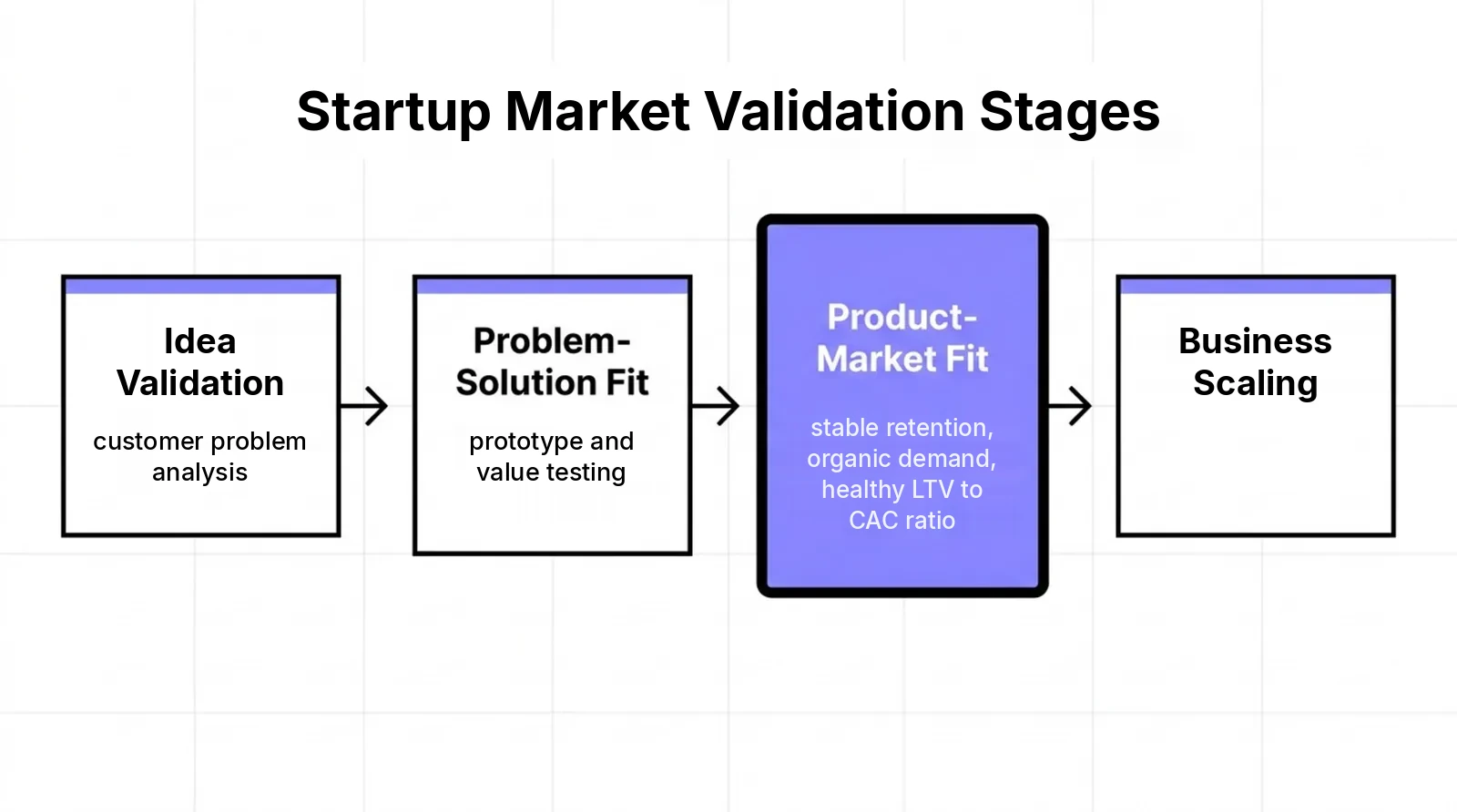
Product-Market Fit: How to Know Your Startup Has Found It
Product-market fit explained: the signals and metrics that show your startup has it, the red flags of missing it, and a step-by-step plan to find it.
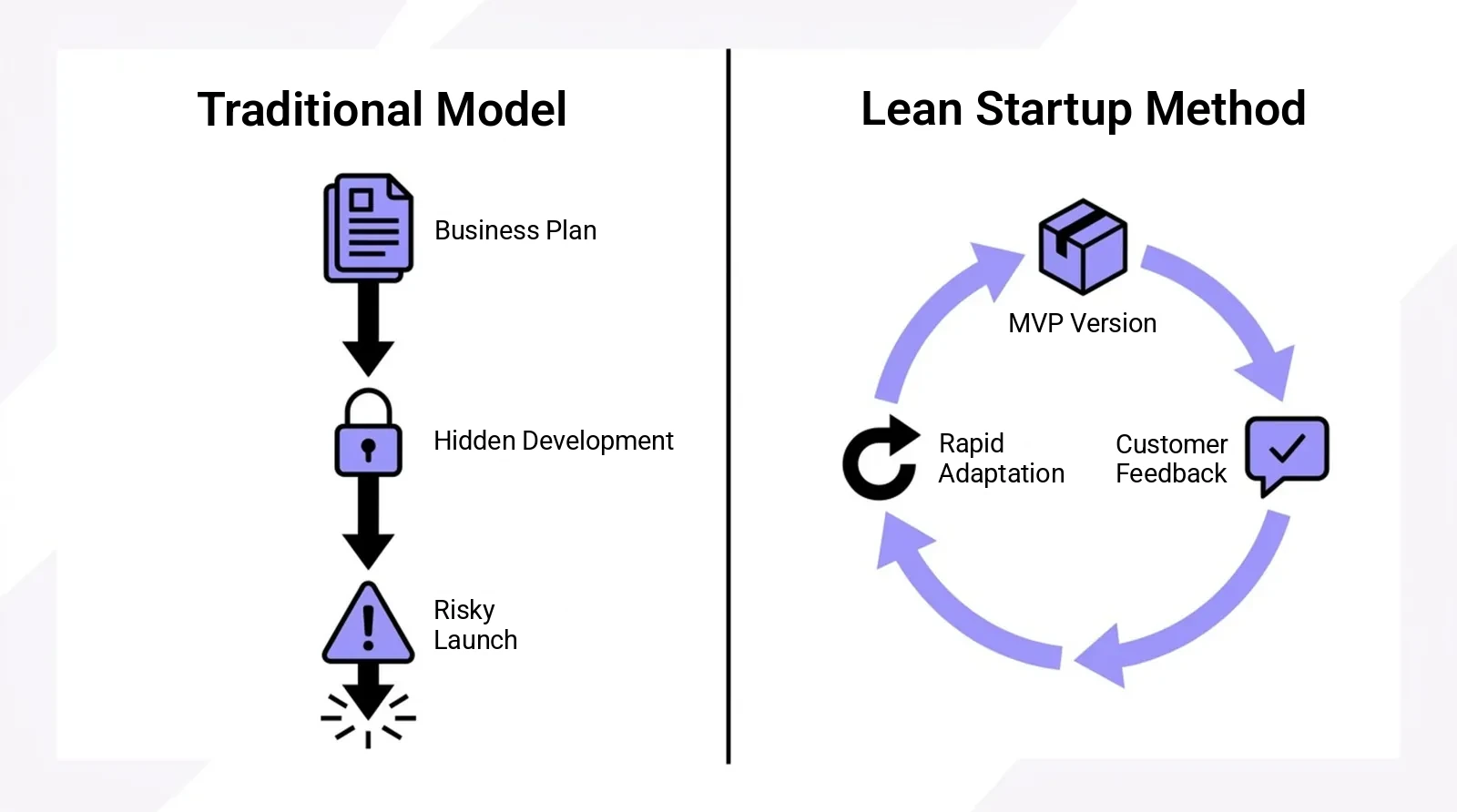
The Lean Startup Method: How to Build a Product Without Wasting Your Budget
The lean startup method step by step: the build-measure-learn loop, MVP, validated learning and pivots. Learn to grow a product without burning cash.