
Cost of Starting a Company in Poland: Sole Proprietorship (JDG) vs sp. z o.o.
What does starting a company in Poland cost? Compare JDG and sp. z o.o.: registration fees, accounting, ZUS, taxes and a realistic startup budget.
Contents
How much does it cost to start a company in Poland, and is it better to choose a sole proprietorship (JDG, jednoosobowa działalność gospodarcza) or a limited liability company (sp. z o.o.)? Registering a JDG costs PLN 0, and you can set up an sp. z o.o. via S24 (the government's online registration system) for under PLN 300, but your real starting budget depends above all on fixed costs: accounting, taxes, ZUS (Polish social security) and a financial cushion for the first months of operation.
Which business form in Poland - JDG or sp. z o.o.?
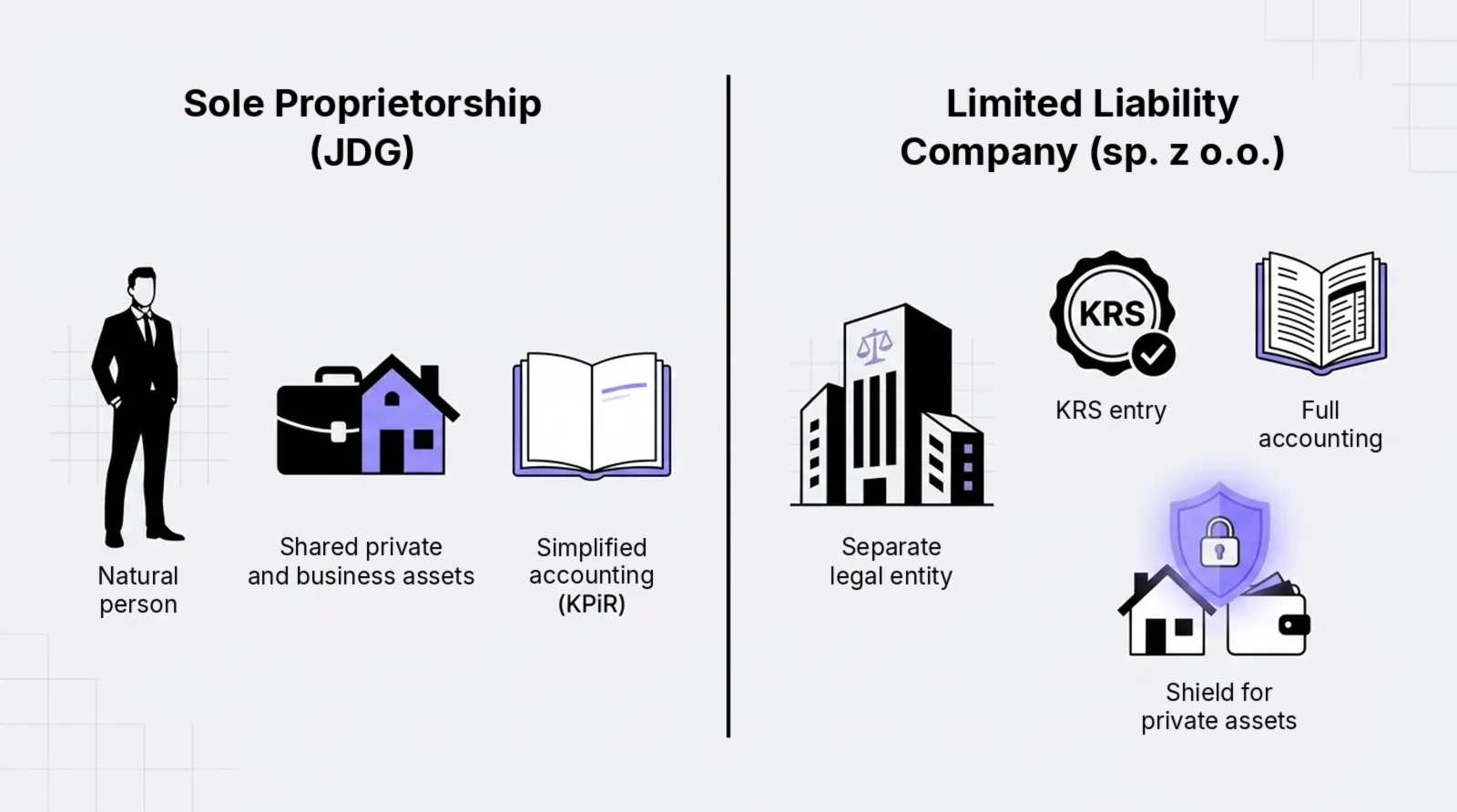
When you start building a company in Poland, you usually choose between two options: a sole proprietorship (JDG) and a limited liability company (sp. z o.o.). They differ in the level of personal liability, the amount of formalities, the type of accounting and the fixed running costs.
A JDG is directly tied to you as a natural person. The business name includes your first and last name, and you are liable for all obligations with your entire private assets. It is a quick and cheap way of validating a business idea. An sp. z o.o., on the other hand, is a separate legal entity entered in the KRS (National Court Register). The main difference: as a shareholder, you are generally not liable with your private assets for the company's debts. For this reason, an sp. z o.o. is the standard where operational risk is higher or for projects aimed at faster scaling.
Comparing the basic legal and organisational differences
The key differences between a JDG and an sp. z o.o. come down to four areas: liability, the registration procedure, the way you settle accounts and ZUS contributions. In a JDG, you and the business are one. You can freely use the money in the business account, and you keep day-to-day records in a simplified form: a revenue and expense ledger (KPiR) or a revenue register if you are on the lump-sum tax (ryczałt).
In an sp. z o.o., the company's finances are completely separate from your private wallet. Every money flow must be properly documented and recorded in full accounting (commercial books), which directly raises the cost of bookkeeping. As a shareholder, you cannot withdraw money without a specific legal basis (e.g. management board remuneration, a dividend resolution or a B2B contract). It is also worth remembering an important trap: a single-shareholder sp. z o.o. obliges its sole shareholder to pay ZUS contributions on terms similar to a JDG.
How much does it cost to start a company in Poland in practice - JDG vs sp. z o.o.
The registration fee is only a fraction of the expenses you will incur at the beginning. To plan your budget properly, you need to add administrative fees, legal services, tools and a cash reserve for the start.
One-off registration costs of a JDG and an sp. z o.o.
Registering a JDG is completely free. An entry in CEIDG (the Central Register and Information on Economic Activity) costs PLN 0. You submit the application online in a quarter of an hour or so, and the business often becomes active the same day. In the same form you can register with ZUS and for VAT.
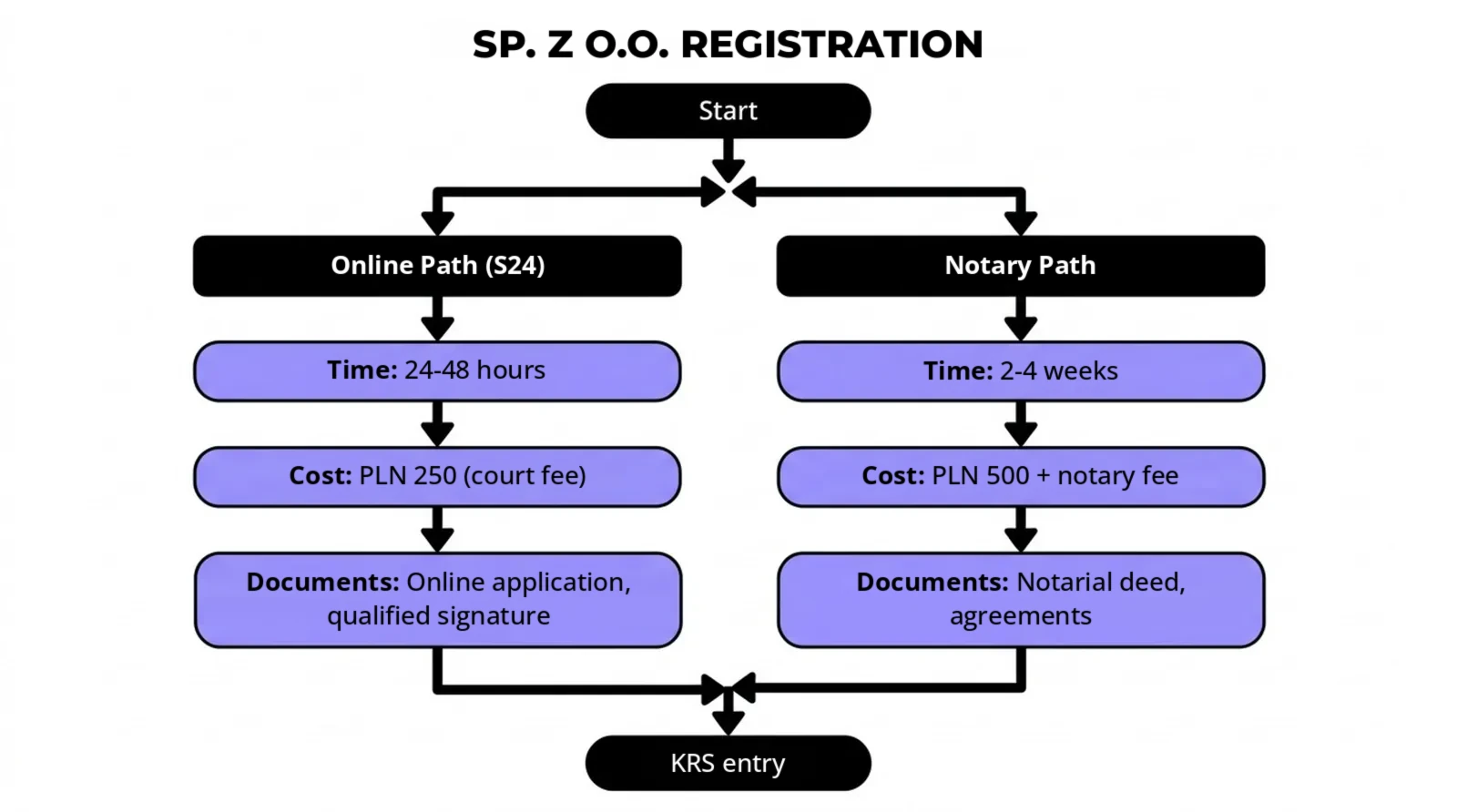
Setting up an sp. z o.o. involves fees whose amount depends on the path you choose. The fastest and cheapest option is the S24 portal: the court fee for the KRS entry is PLN 250 (from 29 November 2025, the fee for the announcement in the Court and Economic Monitor (Monitor Sądowy i Gospodarczy) is PLN 0). On top of that comes the tax on civil law transactions (PCC) of 0.5% of the share capital - with the minimum capital of PLN 5,000 you will pay around PLN 23-25. If you register the company yourself via S24, you will stay under PLN 300. If you commission a law firm or an accounting office to prepare the documents, the total cost will usually be around PLN 1,500.
Online registration via S24 or at a notary - differences in price and formalities
The S24 system is a solution for people who need a standard articles of association without complicated provisions. You use a ready-made template and sign the documents with a free Trusted Profile (Profil Zaufany) or a qualified electronic signature (cost of the signature: around PLN 250-350 per year). You usually get your KRS entry within 24-48 hours.
A visit to a notary is necessary if the articles of association require non-standard provisions: a contribution in kind, different rights attached to particular shares or specific corporate governance rules. The court fee for a traditional KRS application is PLN 500. On top of that comes the notary fee (from around PLN 200 for simple agreements to over PLN 1,000 for higher capital), VAT and the cost of certified copies. The total is usually between PLN 700-900 and PLN 2,500 or more, and the wait for the register entry extends to 2-4 weeks.
Share capital in an sp. z o.o. - is it a real expense?
The minimum share capital of an sp. z o.o. is PLN 5,000. This money does not go to the state - it forms the company's assets, which you can use for day-to-day operations right after registration: buying equipment, a domain, software or goods, or paying for services.
The only non-refundable cost related to the capital is the PCC tax (0.5%). Keep in mind, however, that higher share capital can help build credibility with financial institutions and business partners in larger tenders.
Court and administrative fees - what do you have to pay and how much?
A summary of the basic official fees at the start:
- JDG: PLN 0 for the CEIDG entry.
- Sp. z o.o.:
- KRS entry: PLN 250 (S24 path) or PLN 500 (notarial path).
- MSiG announcement: PLN 0 (abolished from 29.11.2025).
- PCC: 0.5% of the share capital (around PLN 23-25 with PLN 5,000).
Additional expenses may include the stamp duty for a power of attorney (PLN 17, unless it concerns immediate family). VAT-R registration and obtaining NIP (tax ID) and REGON (statistical number) numbers are free. In regulated industries, you have to add fees for licences, permits or entries in registers of regulated activity - you can check the details on the biznes.gov.pl portal.
What are the fixed monthly costs of running a company - JDG vs sp. z o.o.
Registration formalities are a one-off step. The real burden on your budget comes from monthly fixed costs, which you have to pay regardless of whether the company is generating revenue.
Accounting - comparing the costs for a JDG and an sp. z o.o.
In a JDG you can use simplified accounting (KPiR or ryczałt). Market prices start at a few dozen zloty a month for self-service invoicing apps, while full service from an accounting office usually costs PLN 200-500 a month (more with a large number of documents or foreign e-commerce sales).
An sp. z o.o. is legally required to keep full accounting. This translates into higher rates: offers for micro-companies without employees start at around PLN 489-600 a month. For an actively operating company with a dozen or so invoices, the real cost is PLN 1,100-1,500 a month, and once you hire a team and run a warehouse it exceeds PLN 3,000.
ZUS contributions - differences and traps for each business form
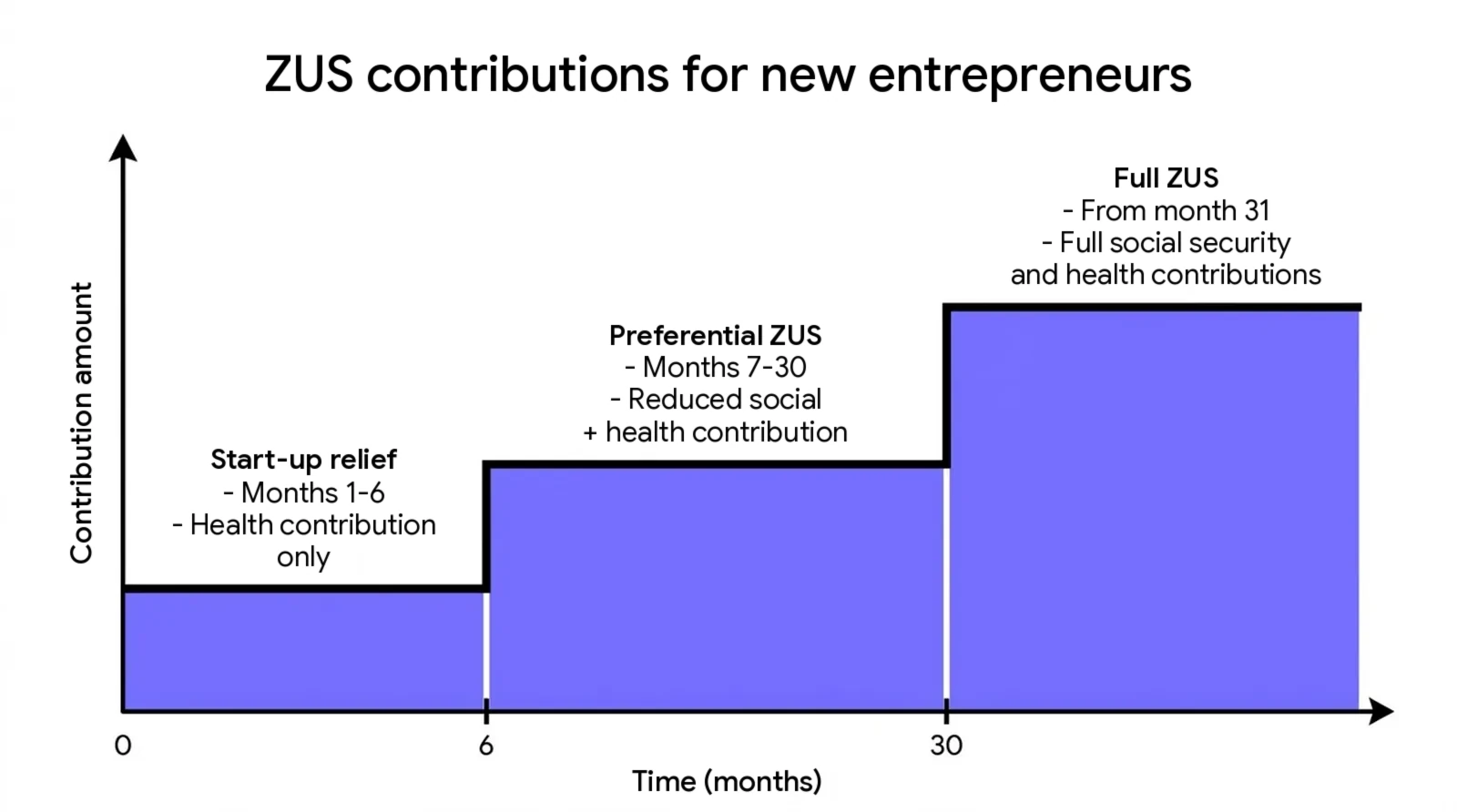
In a JDG, ZUS contributions are one of the main fixed costs. New entrepreneurs can use a package of reliefs:
- Start-up relief (ulga na start, first 6 months): you pay only the health insurance contribution.
- Preferential ZUS (the next 24 months): a reduced base for social security contributions (in 2026 around PLN 456.18 a month) + the health insurance contribution.
- Full ZUS (duży ZUS): once the reliefs run out, social security contributions exceed PLN 1,600 a month + the health insurance contribution.
The health insurance contribution in a JDG applies from day one and depends on the form of taxation:
- Tax scale: 9% of income, with a minimum contribution of around PLN 432.54/month (figures from February 2026).
- Flat tax: 4.9% of income, minimum around PLN 432.54/month (can be deducted/counted as a cost up to a limit of PLN 14,100 per year in 2026).
- Lump-sum tax (ryczałt): a flat rate depending on annual revenue (in 2026: PLN 498.35 / PLN 830.58 / PLN 1,495.04 a month).
In an sp. z o.o., the contribution rules depend on the ownership structure:
- Multi-shareholder company (at least two genuine shareholders): shareholders are not subject to mandatory ZUS by virtue of holding shares.
- Single-shareholder company: the sole shareholder pays full ZUS as in a JDG - in 2026 around PLN 2,757.34 a month (social, health, Labour Fund).
- Appointment to the management board: a 9% health insurance contribution is paid on a board member's remuneration (without social security contributions).
Income taxes and VAT in a JDG and an sp. z o.o.
In a JDG you pay personal income tax (PIT). You can choose between:
- The tax scale: rates of 12% and 32% with a tax-free allowance of PLN 30,000.
- Flat tax: a fixed rate of 19%.
- Lump-sum tax on recorded revenue (ryczałt): rates from 2% to 17% depending on the type of business.
An sp. z o.o. pays corporate income tax (CIT). Small companies (with small taxpayer status) pay a preferential 9% CIT rate (up to the statutory revenue limit), and the others 19% CIT. Paying out profit as a dividend means a second layer of tax (19% PIT), which gives an effective burden of around 26.29% (with 9% CIT) or 34.39% (with 19% CIT). An alternative is the so-called Estonian CIT, under which you pay tax only when profit is distributed from the company, which makes it easier to reinvest money in building the product.
As for value added tax (VAT): the subjective exemption applies up to a limit of PLN 200,000 in annual turnover, excluding certain industries (e.g. advisory services or selected goods). Also remember to integrate with the National e-Invoicing System (KSeF), which introduces new standards for issuing and receiving documents.
Bank, business account and additional fees
In a JDG you can in theory use a personal account, but a separate business account makes bookkeeping and cash flow control easier. In an sp. z o.o., a business account is an absolute requirement. The cost of running an account ranges from PLN 0 (if you meet activity conditions) to around PLN 30 a month, plus possible payment card fees (PLN 5-10/month).
If you plan to sell abroad, check the costs of SWIFT transfers (PLN 30-150) and the currency spreads of commercial banks (3-6%), which can reduce your margin. In such scenarios fintech platforms (Revolut Business, Wise) work well. In e-commerce there is also the payment gateway commission (Stripe, PayU, Przelewy24), averaging 1.5-3% of the transaction value.
Other fixed costs and administrative obligations
Apart from accounting and taxes, the fixed budget also includes:
- Registered office address / virtual office: PLN 46-500 a month, if you do not register the company at a private residence.
- IT infrastructure: domain, hosting and mailboxes (around PLN 20-80 a month or PLN 200-300 a year).
- Software: an office suite (Google Workspace / Microsoft 365) costs around PLN 30-100 a month per user, and an invoicing and KSeF system PLN 0-100 a month.
- BDO register (Polish waste database): an annual fee for companies placing packaging on the market (PLN 100 for micro-enterprises, PLN 300 for others) plus an annual waste report (PLN 300-600 for the service).
- Legal formalities: reporting beneficial owners to CRBR (the Central Register of Beneficial Owners, free for an sp. z o.o.), implementing GDPR (RODO) documentation and terms of sale.
Which expenses can surprise you when starting and running a company?
Failing to account for business-related side costs is a common reason for cash flow problems at an early stage of a company's development.
Costs of changing your business form in the future
Moving from a JDG to an sp. z o.o. through a transformation involves preparing a transformation plan, having the assets valued by a statutory auditor and notary fees - a cost of the order of a dozen or so thousand zloty. Liquidating an sp. z o.o., in turn, is a process lasting at least six months, generating costs of around PLN 3,000-10,000 (announcements, liquidation balance sheets, the liquidator's fee). A simple amendment to the articles of association at a notary (e.g. changing the registered office or PKD business activity codes beyond the S24 catalogue) costs around PLN 500-1,500 plus a PLN 250 court fee.
Additional obligations: BDO, CRBR, GDPR and industry regulations
Administrative penalties for failing to meet registration obligations (BDO, CRBR, missing required GDPR consents) can range from a dozen or so to several dozen thousand zloty. In cross-border trade, you also face local recycling fees (e.g. the LUCID register in Germany) and the cost of foreign VAT OSS returns.
Liability, property and other insurance policies
Business third-party liability (OC) insurance costs around PLN 200-800 a year for standard B2B services. For technology, medical or manufacturing contracts, the sum insured must be higher, which raises the premium. It is also worth considering insurance for electronic equipment, a cyber policy and legal protection.
Marketing and tool costs - unexpected expenses at the start
Creating an offer is one thing, but reaching customers requires a planned marketing budget. Basic visual identity and a website cost from PLN 300 to several thousand zloty. A budget for testing paid ad campaigns (Google Ads, Meta Ads) usually requires at least PLN 1,000-1,500 a month, not counting automation and email marketing tools (PLN 50-200/month).
What forms of start-up financing are available?
Securing financing determines how long your company can stay on the market without regular revenue.
Own funds or external financing - which to choose?
Building a company with your own money (bootstrapping) gives you full independence and no pressure from creditors or investors. The downside is a limited pace of growth and the need to tie up your private savings. A safe model assumes a financial reserve covering at least 3-6 months of fixed operating costs.
The alternative is combining your own funds with external sources: loans, grants or capital from business angels.
Non-repayable grant from the labour office - conditions and options
One-off funds from the District Labour Office (PUP) for starting a business are a non-repayable form of support (once the terms of the agreement are met). In 2026, the maximum grant was up to PLN 57,377.28 (until 31 August), and from 1 September 2026 the limit was set at PLN 55,398.78. In practice, offices most often award amounts of around PLN 30,000-48,000.
Limitations: the grant is available to people registered as unemployed and only covers setting up a JDG (it does not cover an sp. z o.o.). It requires keeping the business running for at least 12 months, securing repayment (a guarantee, a promissory note) and a detailed settlement of expenses with invoices.
Start-up loans and other support instruments for new companies
For projects that do not qualify for a labour office grant, alternatives include preferential EU-funded loans (e.g. from the "Pierwszy biznes - Wsparcie w starcie" (First Business - Support at the Start) programme) or commercial loans, which require a business plan and collateral.
In the idea validation phase, you can also use business incubators, which lend you their legal personality for issuing invoices in exchange for a monthly subscription fee, without having to register a JDG or a company in the KRS. For technology projects with high growth potential, a natural step is often raising equity support from a business angel or a pre-seed fund.
Start-up budget checklist - which costs do you realistically need to factor in?
A list of expenses worth putting into a spreadsheet before registering an entity:
One-off set-up costs
- JDG registration: PLN 0 (CEIDG).
- Sp. z o.o. registration (S24): PLN 250 (KRS) + PCC around PLN 23-25 (with PLN 5,000 capital). Total: under PLN 300 (on your own) or around PLN 1,500 (with legal/accounting support).
- Sp. z o.o. registration (notary): PLN 500 (KRS) + notary fee (around PLN 200-1,000+ + VAT) + PCC around PLN 23-25. Total: from PLN 700-900 to PLN 2,500+.
- Share capital (sp. z o.o.): min. PLN 5,000 (the company's working capital).
- Qualified electronic signature: around PLN 250-350/year (optional).
- Sworn translations: around PLN 50-80/page (for documents of foreign shareholders).
- Company stamp: PLN 50-150 (optional).
- Power of attorney: PLN 17 (stamp duty, if required).
- Licences and permits: at the rates applicable to the given industry.
Typical monthly and annual costs
- ZUS (JDG):
- Start-up relief: PLN 0 social security, only the health insurance contribution (from February 2026 min. PLN 432.54/month).
- Preferential ZUS: around PLN 456.18/month social security + health insurance contribution.
- Full ZUS: over PLN 1,600/month social security + health insurance contribution.
- ZUS (sp. z o.o.):
- Multi-shareholder company: PLN 0 ZUS by virtue of holding shares.
- Single-shareholder company: around PLN 2,757.34/month (full set of contributions).
- Remuneration for a board appointment: 9% health insurance contribution on the gross amount.
- Accounting:
- JDG (simplified): from PLN 229/month.
- Sp. z o.o. (full): from PLN 489/month for micro-companies; PLN 600-1,500/month for an active small company.
- Virtual office / address: from PLN 46 to several hundred PLN/month.
- Business account: PLN 0-30/month (+ transaction fees).
- Domain, hosting, email: around PLN 20-80/month (billed annually).
- Invoicing software / KSeF support: PLN 0-100/month.
- Office tools (Google Workspace / M365): around PLN 30-100/month per user.
- Liability insurance (OC): around PLN 200-800 a year.
- BDO register: PLN 100/300 a year + reporting PLN 300-600 a year.
- Income taxes (PIT/CIT) and VAT: depending on your financial results.
Hidden expenses and emergencies
- Marketing budget: training PLN 300-2,000, ad campaigns PLN 500-5,000/month, SEO from PLN 1,000/month.
- Payment provider fees: 1.5-3% of the value of online transactions.
- Currency conversions and international transfers: fees and currency margins.
- Legal review and implementation: B2B contracts, e-commerce terms and conditions, privacy policy.
- Financial runway: a capital buffer for 3-6 months of the company's regular operation.
- Unexpected operating costs: equipment replacement, breakdowns, formal penalties.
When a JDG and when an sp. z o.o.? - real benefits, risks and the break-even point
The choice of legal structure depends on your risk profile, planned scale, number of shareholders and how you want to pay out profits. The registration cost is of secondary importance - what matters are the monthly tax and contribution burdens.
Tax aspects and personal liability
A JDG is the optimal starting solution for low operational-risk businesses (e.g. consulting, programming services, solo project work). It offers flexibility in using cash and low accounting costs. The downside remains full personal liability for the business's obligations.
An sp. z o.o. works well where there are higher transaction volumes, employees, contractual risk or a wish to build an entity with several shareholders. It protects your private assets, but requires discipline in keeping the accounting books and taking the rules of dividend taxation into account.
When does it pay to switch from a JDG to an sp. z o.o.?
Switching to an sp. z o.o. becomes justified from a business point of view at a few specific moments:
- Revenue threshold: with steady revenue of around PLN 300,000-500,000 a year, the benefits of 9% CIT and ZUS optimisation in a multi-shareholder company may outweigh the higher costs of full accounting.
- Increased business risk: entering manufacturing, construction or large-scale e-commerce, or carrying out contracts with high contractual penalties.
- Bringing in shareholders and investors: raising funding from business angels or VC funds requires a structured capital company form.
- Scaling the team and assets: the need to separate the company's assets from the founder's private finances.
It is worth consulting the decision to change your legal form with a tax adviser, based on real financial data from your business.

FAQ - the most common questions about the cost of setting up a company in Poland
Is registering a JDG completely free?
Yes, the CEIDG entry itself costs PLN 0. Keep in mind, however, that from the moment of registration you must pay the monthly health insurance contribution (from February 2026 at least PLN 432.54/month), and after the start-up relief ends - also ZUS social security contributions, on top of ongoing accounting and tool costs.
How much does it cost to maintain an sp. z o.o. in 2024/2025?
In 2026, basic upkeep of a micro sp. z o.o. (no employees, a small number of invoices) costs around PLN 600-800 a month for full accounting. For an actively operating company, accounting and administrative costs average PLN 1,100-1,500 a month. If the company has only one shareholder, full ZUS contributions are added (around PLN 2,757/month).
Can I start a company without my own capital?
Yes, by choosing a sole proprietorship (JDG), which does not require any initial capital contribution. For an sp. z o.o., a contribution of at least PLN 5,000 is required, which remains at the company's disposal. You can also carry out initial validation of your idea as an unregistered activity (działalność nierejestrowana) - in 2026, the revenue limit is PLN 10,813.50 per quarter without having to register in CEIDG or pay ZUS.
Is it possible to change your company's form without losing liquidity?
Yes, as long as the process is planned in advance. A formal transformation of a JDG into an sp. z o.o. requires a budget of several to a dozen or so thousand zloty for legal and accounting services and an audit. An alternative is setting up a new sp. z o.o. and gradually moving business operations over to it.
How much should you actually budget to start a company - a practical summary
The budget for starting a company in Poland is much more than registration fees at the office or court. It is the sum of one-off formalities, monthly tax and contribution obligations, tool costs and the necessary financial reserve.
Instead of being guided solely by the zero cost of registering a JDG, analyse your runway - the number of months you can sustain yourself and the company without steady income. A safe buffer is the equivalent of 3-6 months of planned expenses. Choose a legal form that fits your business model: go for a JDG if you value simplicity and low start-up costs, or choose an sp. z o.o. if limiting personal liability and building a structure for working with shareholders or investors is key.
Keep reading
All articles →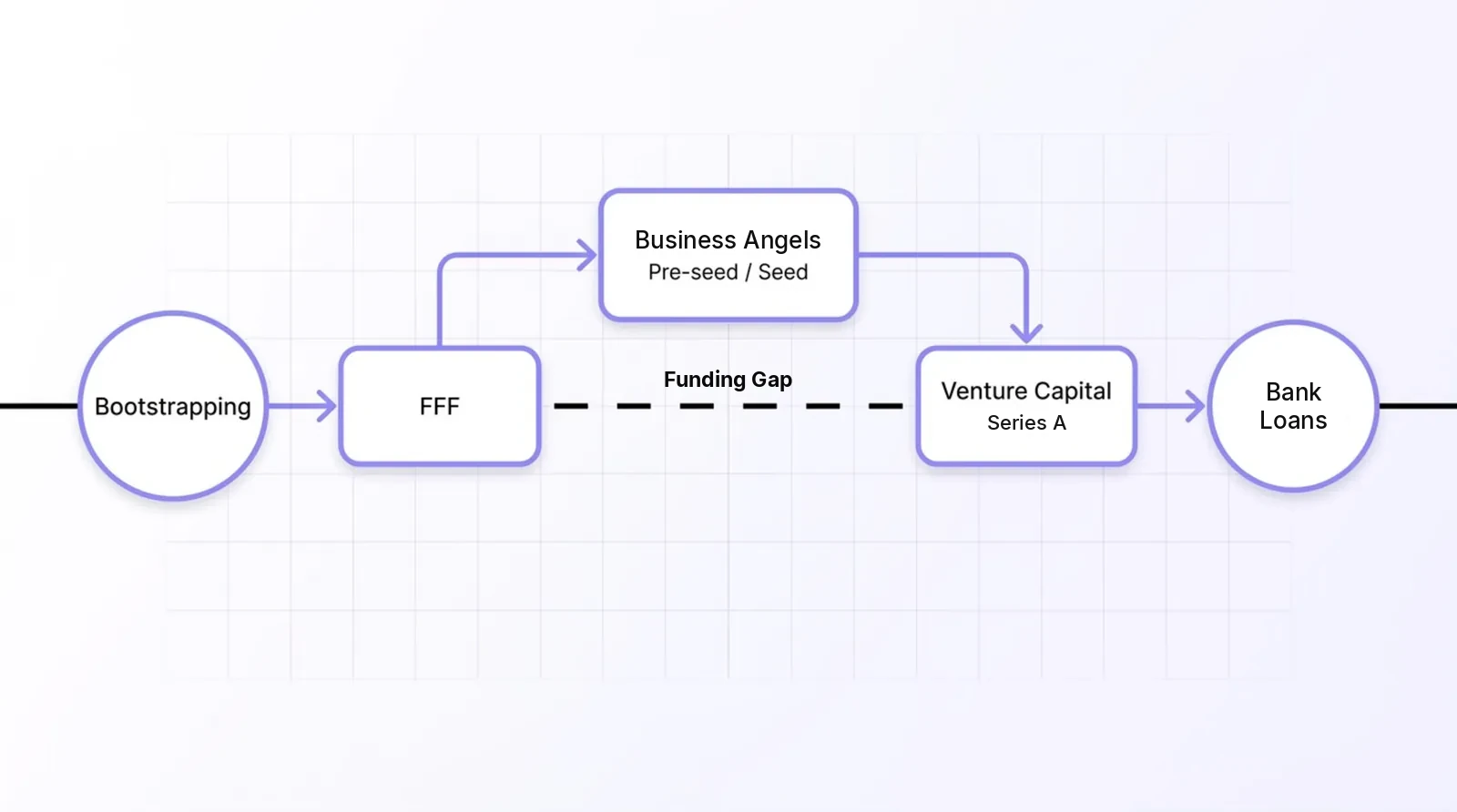
How to Find a Business Angel in Poland: Where to Look and First Steps
How to find a business angel in Poland: angel clubs, events and platforms, active investors, and how to prepare your pitch and first meetings.
How to Build an MVP Without Losing Your Mind: A Practical Guide
How to build an MVP step by step: definition, process, key metrics, common mistakes, legal basics and examples of companies that started with an MVP.
How to Find a Co-Founder Without Destroying Your Startup
How to find a co-founder for your startup: where to look, how to test the fit in a trial project and what to put in your founders' agreement.